MATERIAL / GEOLOGY
How is stone born?
From magma to rock. Discover a stone through its crystals.
01 / FORMATION
Crystals grow deep underground.
Aji stone is granite, a plutonic rock formed as magma cooled slowly underground rather than erupting as lava. Quartz, feldspar and mica contribute to its character.
Where and how quickly magma cools influences its texture. Slow cooling at depth allows crystals to grow; rapid cooling near the surface can produce fine-grained or glassy material.
HOW ROCKS ARE BORN
How does stone come into being?
Slide sideways to explore their origins →
Magma cools and solidifies.
Igneous rocks
Plutonic rocks
Cool slowly, deep underground
- GraniteAji stone belongs here
- Diorite
- Gabbro
Volcanic rocks
Cool rapidly, near the surface
- Rhyolite
- Andesite
- Basalt
- Obsidian
Sediment accumulates. Existing rock transforms.
Origins other than the cooling of magma
Sedimentary rocks
Sand, gravel and biological material accumulate
- Sandstone
- Conglomerate
- Limestone
- Chert
Metamorphic rocks
Existing rock changes under heat or pressure
- Marble
- Gneiss
- Schist
Representative rocks grouped by how they form. Metamorphic rocks can originate from igneous, sedimentary and other rocks.
03 / EXPOSURE
From deep underground to the surface.
Rock formed underground becomes exposed through uplift and the weathering and erosion of overlying rock. Formation, uplift and erosion each take place over long spans of time.
Aji stone is commonly described as having formed about 80 million years ago, during the Cretaceous. Its story continues in the stone quarried today.
THE INGREDIENTS OF STONE / 07 MINERALS
Seven grains that build stone.
Rocks are gatherings of minerals. Compare seven common types through colour and form.
| Group | Mineral | Typical colour | Clues to identification |
|---|---|---|---|
| Dark mineralsDARK / 05 | BiotiteBIOTITE | Black to dark brown | Peels into thin sheets in a consistent direction. |
| AmphiboleHORNBLENDE | Black to dark green | Elongated prisms with oblique cleavage angles. | |
| PyroxenePYROXENE | Dark green to brown | Short prisms with cleavage near right angles. | |
| OlivineOLIVINE | Yellow-green to green | Granular, with a glass-like lustre. | |
| MagnetiteMAGNETITE | Iron-black | Metallic lustre; strongly attracted to a magnet. | |
| Light mineralsLIGHT / 02 | QuartzQUARTZ | Colourless to white | Glassy lustre; breaks irregularly. |
| FeldsparFELDSPAR | White to pale pink | Splits along flat planes. A major component of granite. |
Colours are representative. Light minerals can appear white or pink. Not all seven minerals occur in Aji stone.
Mineral classification and features: Kurashiki Museum of Natural History / Kokugakuin University Hokkaido Junior College: Science Education Resources
LOOK INTO AJI STONE
A landscape of crystals within grey.
Look closer at a cross-section of Aji stone. Light and dark grains come together to create its character.
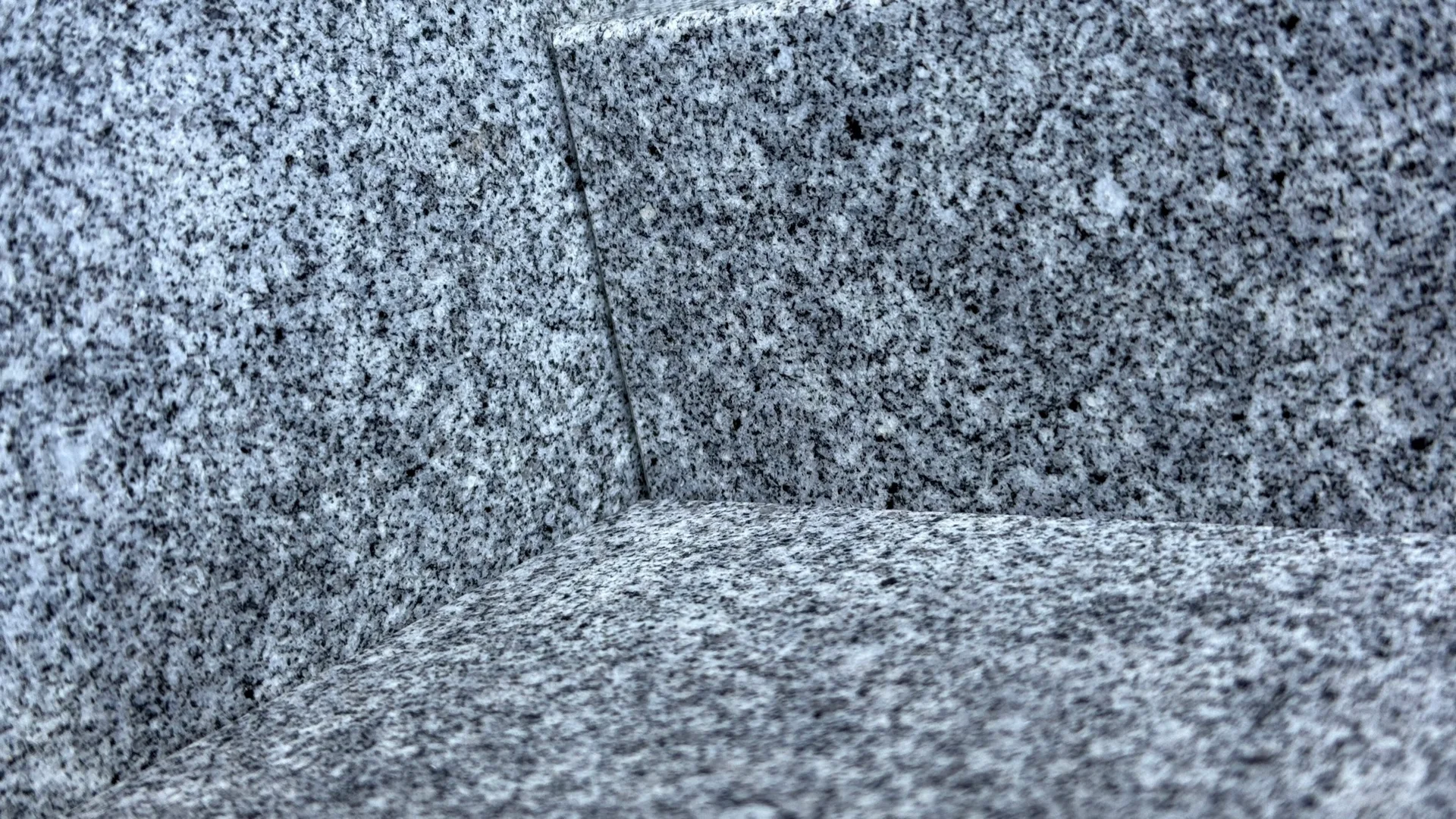
Digital magnification of a cut and polished Aji stone surface. Colour alone cannot identify a mineral. Use arrow keys to move and Esc to close.